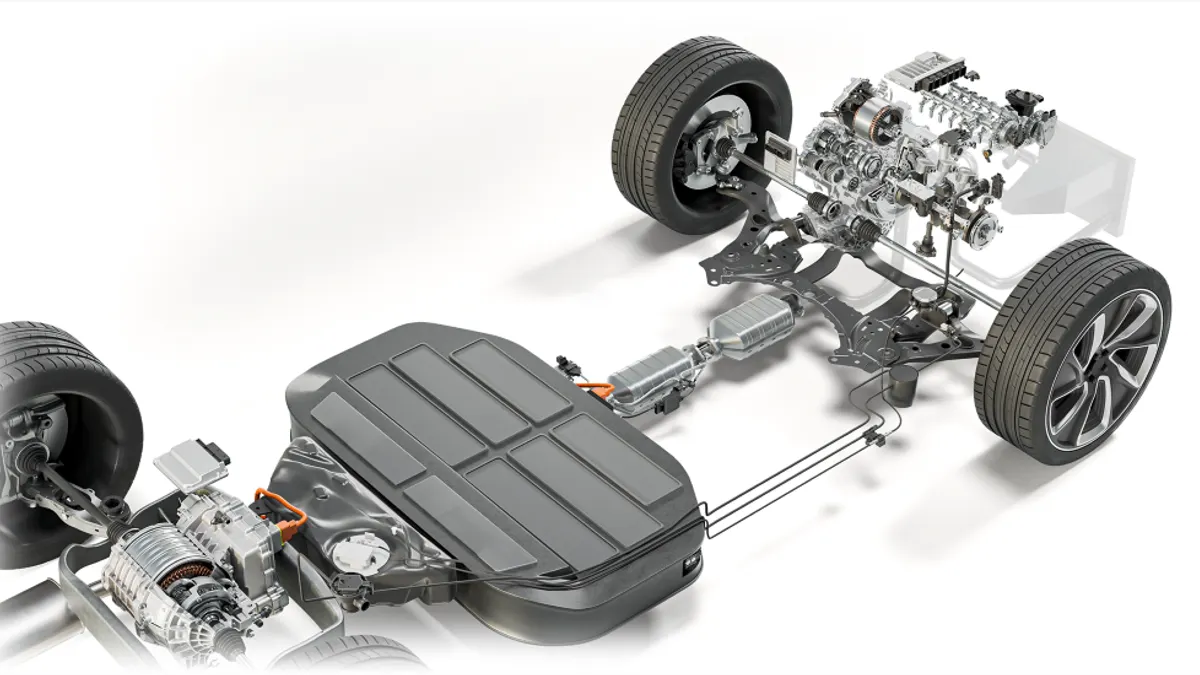

The challenge: As consumer demand for hybrids continues to grow, automakers face a difficult balancing act. They must deliver better fuel efficiency and electrified performance without sacrificing vehicle space, driving range, affordability or existing manufacturing investments.
Developing electrified powertrains requires a deep understanding of how to intelligently integrate electric and conventional propulsion technologies. Hybrid systems must fit within established vehicle architectures, control costs, minimize weight and improve efficiency, all while meeting customer expectations.
The opportunity: Keeping these constraints in mind, Schaeffler engineers hybrid solutions to address market demand.
Where others see constraints, Schaeffler sees innovation
At Schaeffler, space, cost and efficiency are not obstacles to overcome. They are the starting point for engineering innovation. Drawing on decades of expertise in powertrain systems, clutches, torque converters, electric motors and transmission technologies, Schaeffler helps automakers develop integrated hybrid solutions that deliver more performance within space, cost and complexity constraints.
Solving the packaging challenge
Many manufacturers are pursuing multi-propulsion strategies that require hybrid systems to fit within platforms originally designed for conventional internal combustion engines. Creating all-new vehicle architectures for every propulsion type is expensive and often impractical. The solution is smarter integration.
Schaeffler's P2 hybrid technology combines an electric motor, disconnect clutch and torque converter into a highly compact nested architecture. By reimagining the function of the torque converter cover and enabling components to serve multiple purposes, the system maximizes available packaging space while maintaining performance capabilities.
The result is a hybrid solution that delivers electrification benefits without demanding significant vehicle redesign.
Schaeffler's micro torque converter solutions address this challenge by combining proven torque converter technology with advanced hybrid integration. The result is full hybrid capability, outstanding launch performance and efficient packaging within existing vehicle architectures. With P1 and P2 modules, integral torque converters and Multi-Mode hybrid transmissions, Schaeffler addresses high torque requirements across a wide range of vehicle applications.
Reducing cost and complexity in range-extender hybrids
Range-extenders can quickly become complex. Multiple motors, electric axles, high-voltage systems, batteries, inverters and combustion engines often increase cost, mass and packaging requirements.
Schaeffler’s production-ready 400V range extender addresses these requirements and has the potential to improve fuel efficiency depending on a vehicle’s use, energy demand, operating environment and access to charging infrastructure.
Schaeffler's Generator Drive is an integrated solution that consolidates critical functions into a single system.
Combining a torque converter, planetary gearset, clutches, externally excited synchronous motor, overdrive gear and integrated 800-volt silicon-carbide inverter, the Generator Drive supports electric drive, direct engine drive, series-hybrid operation, power-split functionality and exportable power from one compact architecture.
This integrated approach reduces unnecessary energy conversions, simplifies the overall drivetrain and creates significant opportunities for cost and weight savings. Schaeffler estimates the system can provide significant cost and weight savings, compared with a conventional range-extender architecture, while also improving fuel efficiency in key driving scenarios.
Unlocking new efficiency gains through clutch innovations
Some of the most meaningful efficiency improvements come from components that are often overlooked. Schaeffler continues to advance hybrid architectures through innovative clutch technologies designed to improve efficiency.
Schaeffler's switchable one-way clutch combines the wet clutch and hydraulic actuator traditionally used in multi-mode hybrids into one part. This reduces package size and eliminates clutch drag losses. The result is a simpler, more efficient solution that cuts component cost by 40% compared with the system it replaces.
Schaeffler's multi-position clutch also enables a more flexible multi-mode architecture. It adds an engine disconnect, so both e-motors can propel the vehicle together in EV mode while still supporting series and parallel operation. This allows smaller, equally sized motors, reducing motor cost by 30% and drivetrain mass by 17%.
Power-split hybrids also benefit from Schaeffler innovation. An added clutch locks the generator and provides a direct mechanical connection to the wheels at highway speeds. This bypasses the generator when the battery is fully charged and improves overall vehicle efficiency by about 1%.
The Schaeffler advantage: System expertise
Schaeffler’s complete system understanding is unique, drawing upon 80 years of mechanical and electromechanical expertise. Our integrated solutions span torque converters, clutches, electric motors, transmissions, batteries, actuators and hybrid-system integration. This allows us to optimize customer requirements by understanding how components work together, not just how they perform individually.
At Schaeffler, we believe innovation begins with constraints. By solving packaging, cost and efficiency challenges through a system-level approach, we're helping automakers build the next generation of hybrid vehicles that deliver greater value for consumers. The future of hybrid technology isn't about integrating more. It's about integrating smarter.