Editor's note: This story is part of the WardsAuto digital archive, which may include content that was first published in print, or in different web layouts.
One of the most under-mentioned aspects of driving electric is the so-called “EV Grin.”
EV proponents often talk about the automatic happiness that appears on your face when stepping on the accelerator and the instant torque propels you forward. But it’s overwhelmed by one of the most over-mentioned emotions associated with driving electric: range anxiety.
The solution, as is so often the case at the Consumer Electronics Show, is technological. At this week’s all-digital show, Bosch and HERE Technologies explain how they’re working together on new ways to not only reduce range anxiety, but also address other challenges that come from swapping fossil fuel for electrons.
HERE is making several announcements at CES, including advances in 3D mapping and privacy tools and a new EV Routing feature that optimizes suggestions so drivers take the most efficient routes.
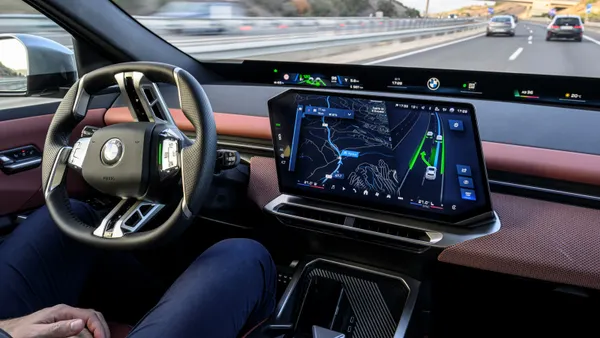
HERE accomplishes this by combining topography and live traffic information in navigation systems along with Bosch’s detailed information about a particular EV’s consumption numbers.
EV Routing can give drivers live updates about nearby charging locations, availability and pricing. This information comes from HERE’s EV Charge Points database which draws from 80,000 data points.
Bosch also will join HERE’s Navigation On Demand (HNOD) software-as-a-service suite. HNOD is an application that combines “the best of in-vehicle navigation and mobile and connected solutions,” says Knuth Sexauer, vice president-sales at HERE Technologies.
“Now, what’s coming along is a lot of information that EV drivers very specifically need…When you are calculating a route, you obviously need to consider some things that are completely different than (with) an internal-combustion engine.”
Combining Bosch’s powertrain knowledge with HERE’s detailed EV information gives drivers “much, much higher range accuracy,” Sexauer says, which could mean skipping a charging session because the system confirms the driver can reach the destination with the power onboard.
Bosch also will help drivers decide which charger to visit when they do need juice, says Carolin Reichert, Bosch’s vice president-connected mobility solutions and E-Mobility. Currently, the German supplier and its partners offer dynamic information on around 600,000 charging stations.
“There are some EV drivers who want to charge as cheap as possible. Others prefer to charge as fast as possible and that, of course, also has an impact on the route,” she says.
Once an EV is plugged in to a public charging spot, Bosch’s plan is to support the driver by offering personalized recommendations.
“We all know that charging takes some time, so it’s important to know: Can I go to a restaurant close by, can I do some shopping?” she says.