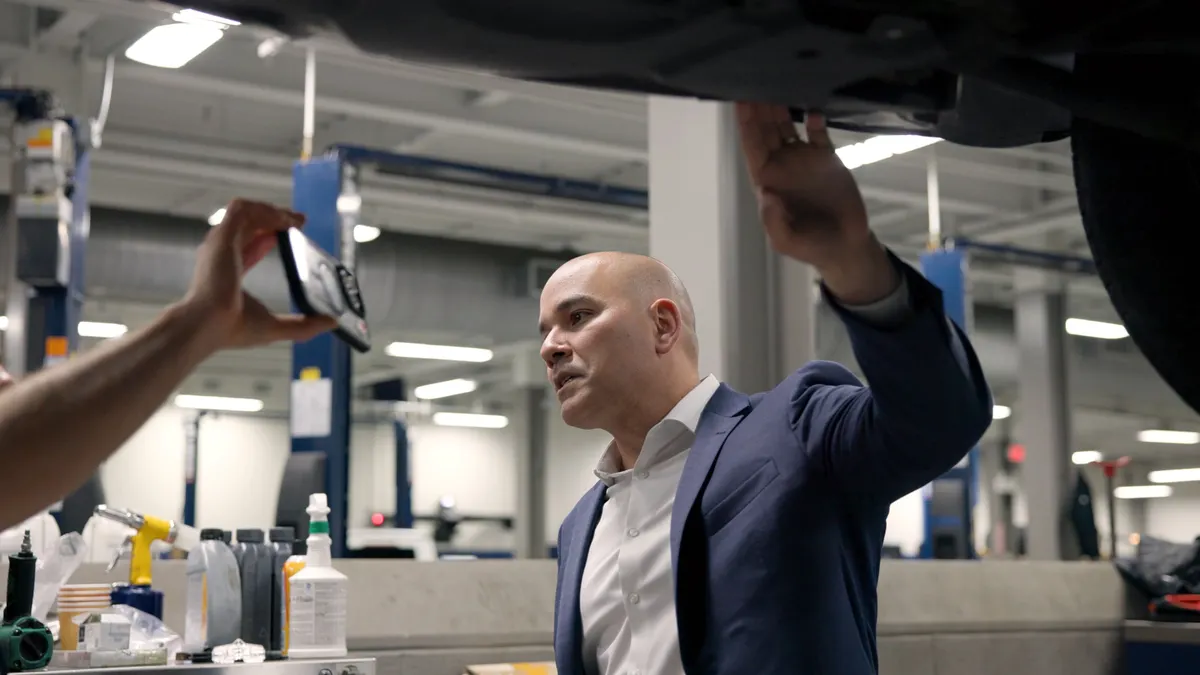
David Cerqueira, the service director at Benzel-Busch Mercedes-Benz has worked at the dealership for more than 17 years and knows his customers well. That’s why he generally shies away from using AI agents to directly message customers.
“If we’re not doing it the old-fashioned way, picking up a phone call and explaining it, or a well-written email or text, it’s a no-go. It doesn’t work here,” Cerqueira told Wards Auto on a Zoom call.
That doesn’t mean the service department at his Englewood, New Jersey, dealership doesn’t use AI in its customer communication, however. It does, particularly when it comes to refining writing and marketing copy.
In fact, using AI in customer communications has dramatically boosted repair order turn time, Cerqueira said, among other benefits. Here’s a guide to some of the ways the Englewood, New Jersey dealership is using AI.
Crafting a well-written response
Benzel-Busch Mercedes-Benz employs 43 service technicians, Cerqueira said, and while they may be highly skilled technicians, not all are superior wordsmiths.
That’s where AI comes in: Some 30 of his techs use a texting platform from CDK Global to polish their texts before sending them.
The tool speeds up the writing process and ensures the response is fully legal. Cerqueira said that’s an upgrade after years of people having to set aside time to figure out what the best and legal response would be. Now, “we’re like nope, time out, this is how AI is going to formulate it for us,” he said.
The AI platform also helps create more clear explanations for very complex repairs, Cerqueira added.
And it has significantly reduced repair order turn time. Cerqueira said the dealership measures the number of days a vehicle was in the service department, from when the repair order was first written to when it was closed. After the dealership began using AI in communications, “we went from 6.5 days to 4.3 days total repair order time,” he said.
Writing compliant technician repair stories
Benzel-Busch Mercedes-Benz technicians use Microsoft Copilot when writing repair stories for warranty repairs, Cerqueira said. They simply upload the repair information and ask Copilot to put together a repair story.
Technicians’ repair stories, especially those for warranty repairs, must be compliant and address the cause and correction — the 3C’s. Besides ensuring the repair stories meet those requirements, using AI speeds up the process, which is particularly helpful for technicians.
“Flat-rate technicians, they’re fighting the clock all day long,” Cerqueira said.
Explaining vehicle features
Customers often call the service department to ask how to use some of their new vehicle’s features.
As it’s impossible to know every feature off the top of your head, a request for how to update an owner’s Mercedes-Benz user experience profile would typically involve going through a guidebook. That’s no longer the case. Now, the service department uses AI to find the answer.
“It’s like step one through five, you’re literally copying and pasting because it’s doing the work for you, digging into MBUSA’s website,” Cerqueira said.
Creating marketing materials
Benzel-Busch Mercedes-Benz has a mobile service van that is fully wrapped with the dealership’s name and an image of a Formula One pit crew. Years ago, the dealership would have had to rely on an external agency to create that art and the marketing material around it.
Now, AI can help with art and marketing materials. As an example, Cerqueira said the dealership once used Anthropic’s Claude AI to create a flyer “in about 45 minutes.”
Improving technician onboarding
AI has improved the technician onboarding process. Cerqueira uploaded the Mercedes-Benz Drive Program to an AI platform. He then told the AI he had a new technician who had no dealership experience, but graduated from Universal Technical Institute with extra training specific to the Mercedes-Benz Drive Program.
The AI tool then looked at all the courses the new technician took and created an onboarding checklist that could help ensure the new technician had everything needed to start.
The checklist included items that were as straightforward as “how many tools do they have?” Cerqueira said. “A lot of times, it’s, like, the most obvious stuff, but who’s really thinking through the whole checklist?”
Future AI uses
Cerqueira will soon begin using DamageSpeX from TraXtion, a firm with AI-powered diagnostic software and hardware. The AI-powered damage detection software captures a vehicle’s condition without a walkaround.
Mercedes-Benz of Englewood has a fleet of about 150 loaner cars. Having a record of any damage reduces the dealership’s risk when a loaner car returns with damage. It also protects the service department when a vehicle comes into the shop for a repair.
Cerqueira currently has three people in the service lane “walking around with iPads, taking photos of customers’ cars on the inbound and loaner cars on the outbound,” he said.
Using the damage detection software will eliminate that need, which is a positive. “Let’s face it, those are roles nobody wants to do anyway,” Cerqueira said.