Dive Brief:
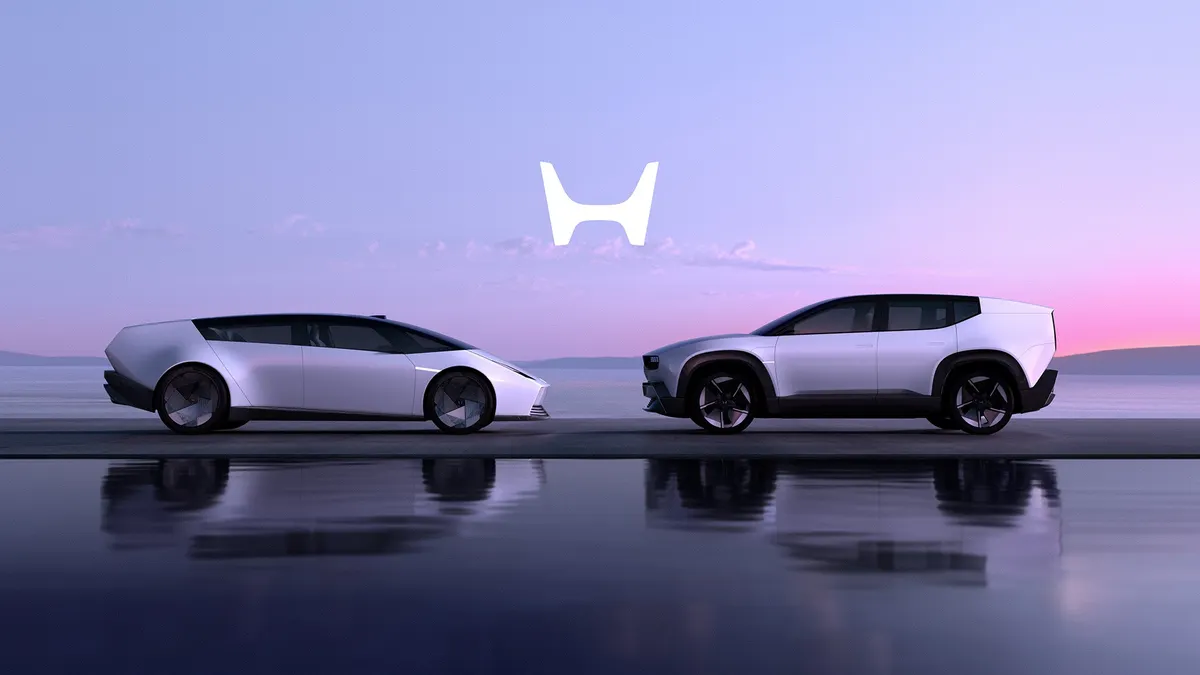
- On Wednesday, Honda confirmed the cancellation of three EVs that had been announced for the U.S. market — the 0 Series Saloon, 0 Series SUV and Acura RSX.
- The decision comes from a “reassessment of the company’s automobile electrification strategy,” which Honda had mentioned in a Feb. 10 earnings presentation.
- Honda revised forecasts to anticipate a net loss for this fiscal year, following a $1.7 billion loss for the previous three quarters. It now expects to report expenses and losses of up to 2.5 trillion yen ($15.7 billion) over a longer term due to the EV turnaround, as it aims to “further strengthen its hybrid models.”
Dive Insight:
Honda’s automotive business has “fallen into an extremely challenging earnings situation,” it reported with Wednesday’s announcement. That includes a decline in profitability of its gasoline and hybrid vehicles due to tariffs, plus the intensification of competition in China as the market undergoes a rapid shift toward software-defined vehicles and shorter development cycles.
“In such a difficult competitive environment, Honda was unable to deliver products that offer value for money better than that of newer EV manufacturers, resulting in a decline in competitiveness,” the automaker summed.
Honda now expects to incur losses of up to 1.12 trillion yen ($7 billion), plus up to a 150-billion-yen share of investment loss and special losses of up to 570 billion yen. Underscoring the exceptional nature of the situation, the automaker also confirmed that some Honda executive officers will be voluntarily returning up to 30% of their compensation.
According to the Financial Times, this would be Honda’s first annual net loss since becoming a public company in the 1950s.
The automaker attributes the situation to declining profitability of its automobile business, pointing to the impact of tariffs on gasoline and hybrid models on one side, and to the competitive challenges on the EV front in Asia.
Honda had been seen as relatively cautious about EVs — up until the January 2024 debut of a new global 0 Series lineup, in Saloon and SUV concept form. With that, it aimed to flex its engineering prowess in a “thin, light, and wise” EV showcasing a new look that stood apart from Accords, CR-Vs and Civics. Autonomous driving tech and a true software-defined-vehicle approach were promised for the future, if not at launch.
The automaker also insisted the 0 Series would be made at volume, not just as a flagship model or niche vehicle. And it later backed that up at scale with what it termed its Ohio EV Hub. It revamped its oldest U.S. manufacturing plant in Marysville, Ohio, and readied two other nearby facilities, plus a joint-venture battery plant with LG Energy Solution, to accommodate the mass production of 0 Series EVs on the same assembly line that builds gasoline (and hybrid) models, without slowing the build rate.
As of April 1, Honda put its R&D subsidiary in charge of vehicle development so that the automaker can react more quickly to trends; but Honda also made clear with Wednesday’s announcement that it was canceling development of these EVs, not just their market-launch plans.
The Ohio manufacturing changes will stay in place, however.
“Honda established a highly flexible manufacturing environment in Ohio capable of building the right products to meet customer demand,” American Honda Motor Co. corporate spokesperson Chris Abbruzzese told WardsAuto via email. “That flexibility remains central to our strategy. We will continue producing gasoline and hybrid vehicles at both the Marysville Auto Plant and the East Liberty Auto Plant.
“Additionally, discussion is moving forward as part of our joint venture partnership with LG Energy Solution to localize production of hybrid batteries and Energy Storage Systems at L-H Battery Company in Jeffersonville, Ohio,” he added.
While Honda confirmed the cancellation of three electric-vehicle products, a fourth one hangs in the balance. WardsAuto has reached out to Sony Honda Mobility regarding the future of the Afeela 1 sedan, which had been set to share many core components — and the Ohio assembly facilities — with the 0 Series models.
Honda had been banking a lot on the 0 Series models and their internally developed EV platform, with plans for a true software-defined vehicle approach and a future upgrade of the platform set to gain full system-on-chip flexibility. A recently announced partnership with Texas-based Mythic aims for energy efficiency and AI technologies with analog computing.
Honda promises a “reestablishment” of its mid- to long-term automotive strategy at a press conference in May.