At a March 12 Investor Day held in New York, Lucid Group focused on its technology future through two different lenses that could together put the EV maker on a path toward profitability as it simultaneously pushes to streamline and cut costs.
In the shorter term, it looked at the launch of upcoming Midsize EVs and leaner Atlas drive units set to arrive by the end of the year, and its ongoing efforts to shore up its software operations. And over the longer term, Lucid remained focused on what it sees as the bigger opportunity — in autonomous vehicles.
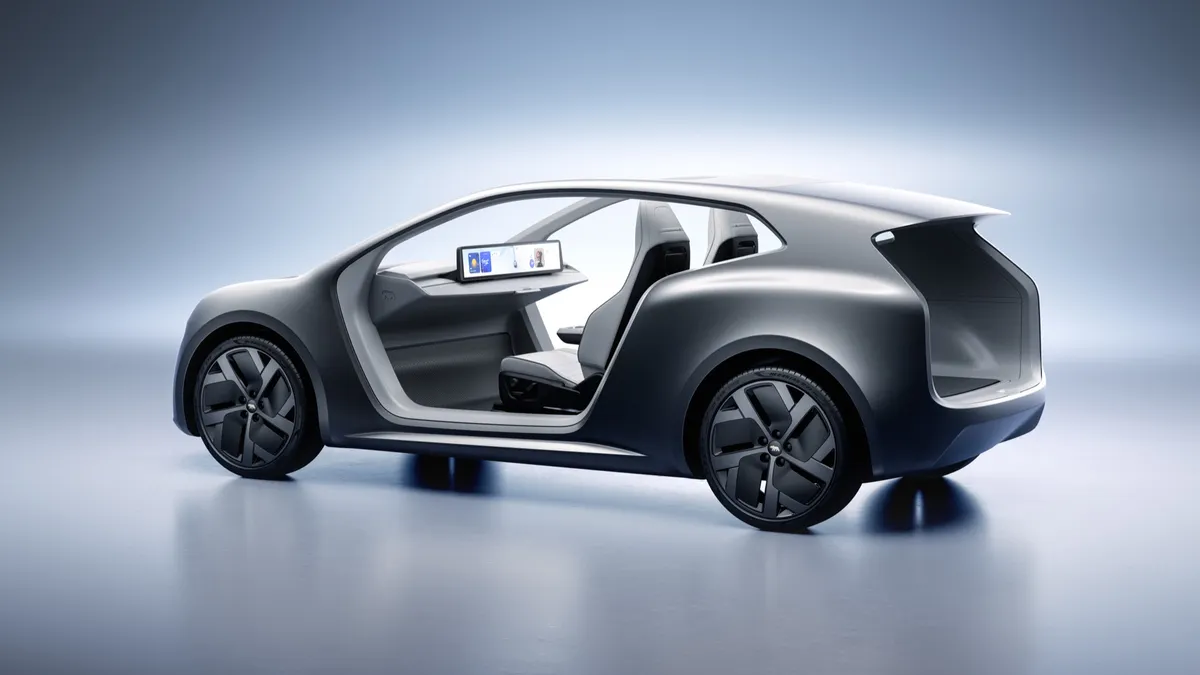
These two pieces of Lucid’s future fit together in Lunar, a robotaxi concept the automaker revealed as based on the Midsize platform, with Lucid interim CEO Marc Winterhoff and Uber President and COO Andrew Macdonald taking a seat in the two-seater.
As part of the presentation, Lucid also confirmed “a continued advancement” of a strategic relationship with Uber Technologies, with the companies working to finalize an agreement to use Lucid Midsize EVs. The new agreement would build on a $300 million investment from the ride-hailing company announced last July, helping bring up to 20,000 Gravity SUVs with SAE Level 4 autonomous-vehicle technology from Nuro.
Earth, Cosmos, and…
Lucid sees its Midsize models, set to launch later this year, as representing a tenfold increase in the brand’s addressable market. Lunar aside, Lucid confirmed three production-bound EVs for the Midsize platform, each very closely related but offering different design statements and positioned toward different types of shoppers.
The first of these set to arrive, the Lucid Cosmos, is due to start under $50,000, and look for efficiency to once again be the enabler for a competitive advantage. Lucid is aiming for 4.5 miles per kWh for at least one version, producing a long driving range from a compact battery, and the shift to a cell-to-pack battery should help keep the cabin packaging space-efficient. At least one of these models will achieve a coefficient of drag under 0.22, according to design chief Derek Jenkins.
The efficiency mindset has translated to one of simplification as well, and the avoidance of unnecessary complexity. The first two, Cosmos and Earth, will share 95% or more of parts and investment, according to Lucid. And as Jenkins promised, the Midsize models will have “mechanical, analog door handles,” for instance.
Efficiency will remain the enabler
Lucid showed, for the first time, images of its Atlas drive unit. While it hasn’t yet detailed what makes this unit technically different versus its current Zeus unit used in the Air sedan and Gravity SUV, it noted that the components are smaller, lighter and simpler. They also have identical front and rear housings and mounts, which will help in building them at scale and achieving cost efficiency.
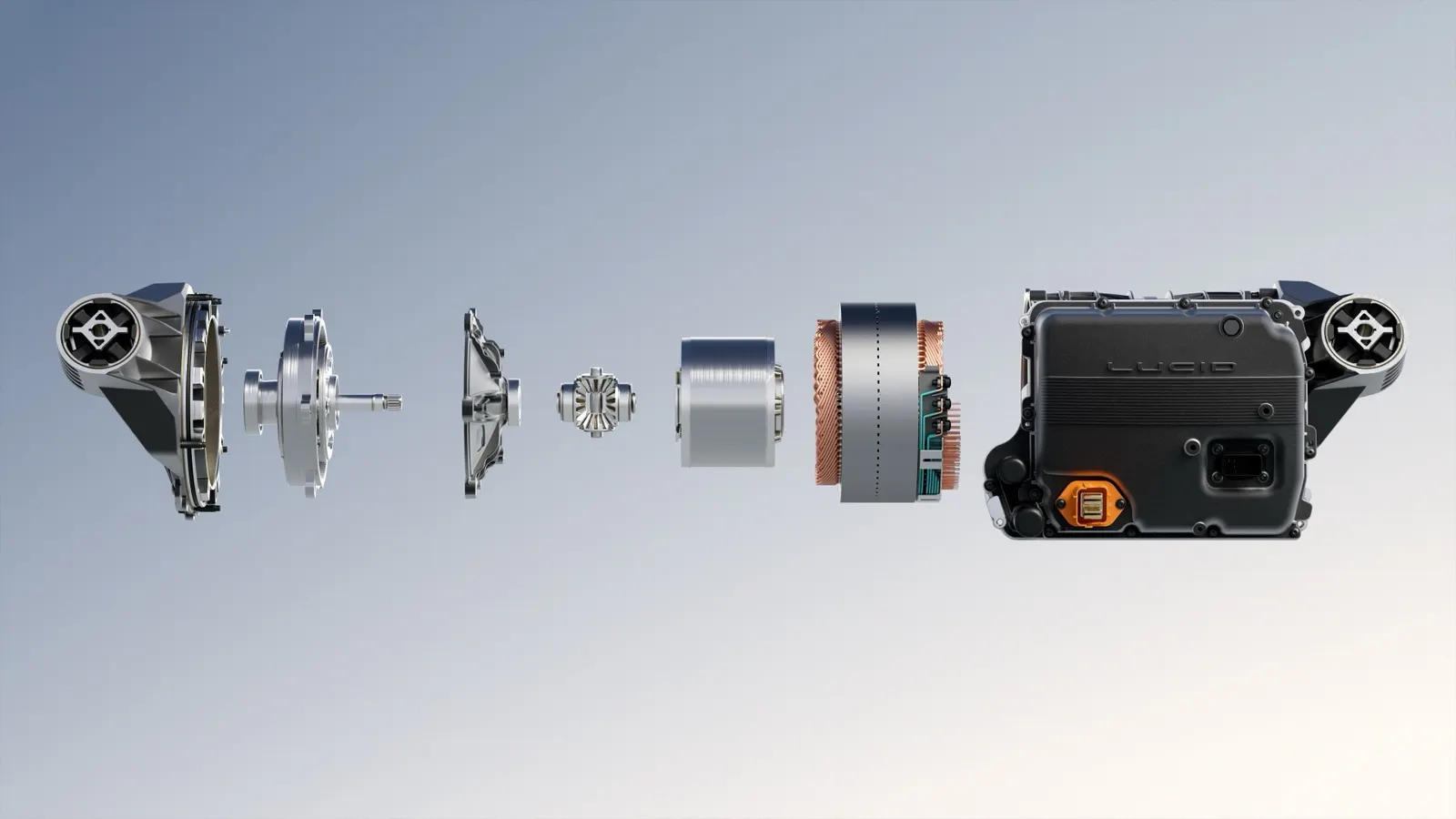
In all, the Atlas assembly has 30% fewer parts and offers a 37% reduction in drive-unit costs, Lucid said. And along with it, the automaker claimed these Midsize models will have radically reduced wire count — even versus other new competing EVs.
But one manufacturing shift that other automakers have billed as a simplification will not be coming to Lucid EVs anytime soon. The automaker emphasized that it is not shifting to large unicastings — often called gigacastings — with the Midsize platform. Instead, for the sake of repairability and lower build costs, Lucid will use a mix of costings, stampings and extruded pieces for the Midsize platform’s steel-and-aluminum construction that it says will save owners about $1,000 a year in insurance.
Lucid didn’t yet confirm a price target for the other two Midsize models, or what sort of sales numbers it anticipates, but it did emphasize that it sees a tenfold increase in the addressable market with the addition of them. The automaker reported that it delivered 15,841 vehicles in 2025 from Air and Gravity, with production and deliveries of the latter ramping up through the year.
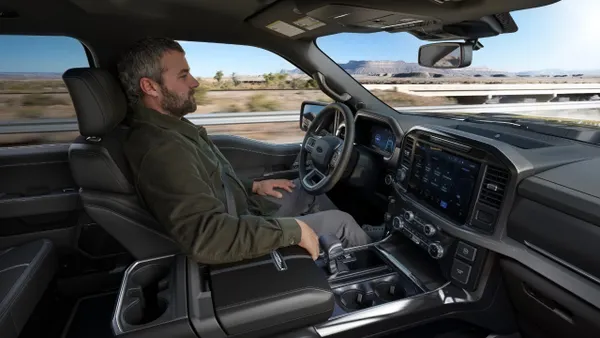
As a bridge toward the company’s sights on vastly higher production volume, full autonomy and robotaxis, Lucid also revealed that it will enable autonomous driving as a monthly subscription in its vehicles — starting in 2027 with a $69-per-month tier offering enhanced driver assistance, then with up to $199 per month for future Level 4 capability that wouldn’t require any driver takeover.