

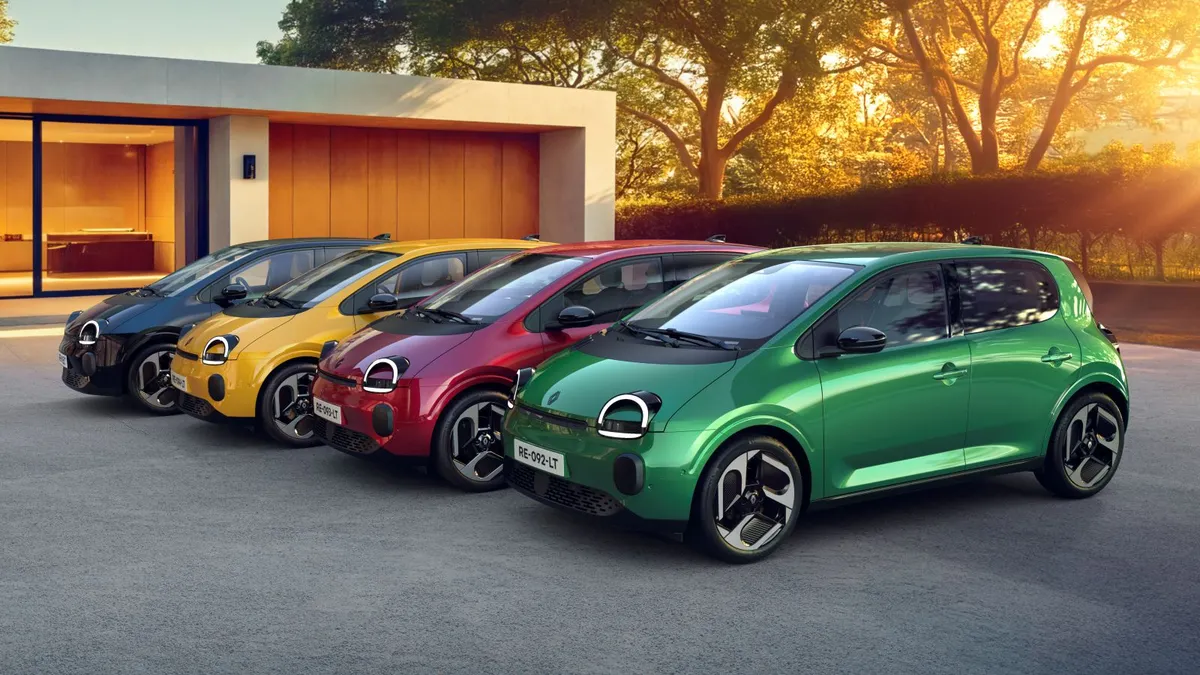
Renault expects to bring electric vehicles to market at the same price point as hybrid models thanks to its new “futuREady” business strategy.
The plan also hopes to copy China’s automotive industry and its ability to achieve a two-year development cycle from drawing board to the showroom for its future vehicles.
In a March 11 interview with CNBC’s Europe Early Edition broadcast, Renault’s CEO, Francois Provost, promised the strategy will enable competitively priced EVs by the end of this decade.
“The problem of EV is the price, the autonomy of the battery, not the technology by itself, so it's why we think that we have to continue to push, to target, to provide to our customer electric cars by 2030 at the price of hybrid,” said Provost. “And then the customer can choose between electric cars or full hybrid, where Renault is also very strong,” he added.
Renault’s chief priority is the speed of developing new models in the future, said Provost. “We did this for the Twingo,” he said. “We launched in a few weeks, and now, with futureREady, our ambition is to put two-year development as a standard,” Provost added.
Speed of development will cut EV production costs by as much as 40% and slash sticker prices by up to 30%, he said.
While the auto group expects growth outside European markets, Provost said it will target potential hotspots like India and South America. “In both cases, we are there for decades, our grounds are strong, and now we dedicate our investment and competitiveness in order to deliver a big growth because the markets are growing very fast in India and South America,” he explained.
Current geopolitical pressures, such as the U.S.-Israel war against Iran, would cause short-term challenges to vehicle volume growth, admitted Provost, although even here the new strategy will help. “So now, with our full digitization of our operation including our Tier One suppliers, but also Tier N suppliers, we are capable, within a few hours, to assess the situation and mitigate very quickly,” he said.
Analyst reaction
Renault’s futuREady strategy is being seen as a positive, forward-looking move at a time when the auto industry is undergoing a structural shift towards software-defined vehicles, said Jato Dynamics’ regional consultant, Steffen Michulski, in an emailed response to WardsAuto.
“The transition from hardware‑centric development to software‑driven architectures is no longer a theoretical future trend, it has already proven to be a major competitive advantage for several fast‑moving global players,” Michulski said.
Early adopters of SDV technology, including Tesla and many China-made brands, have embraced centralized computing and continuous software updates. These vehicles are setting new benchmarks for performance, customer experience, speed of innovation and lower production costs, said Michulski.
Traditional auto development cycles cannot keep pace with digital-savvy consumer expectations, he added. “Renault’s move acknowledges this evolution and positions the company to compete in an environment where software capability is rapidly becoming the primary differentiator among OEMs,” Michulski said.
At the same time, the company’s commitment to further hybrid powertrain development is a pragmatic approach to consumer demands that reflect a slower-than-expected adoption of EVs, he said.
“Hybrid and plug‑in hybrid technologies continue to enjoy robust demand across key European markets, serving as an important bridge for customers who are not yet ready to transition to a fully electric vehicle,” concluded Michulski.
While Renault saying all the right things, Adam Ragozzino, Omdia’s principal analyst for batteries and electric powertrains, spots some potential tension points with the group’s budget brand Dacia.
“The Dacia Spring, the group's least expensive car, is built in China,” said Ragozzino. “Chinese factories are the most automated in the world, changing the relationship with labor.”
As Renault pointed out in its March 10 release, it employs nearly 100,000 people across 9,000 global production facilities, and many of those roles may disappear with higher levels of automation.
China’s manufacturers, such as BYD, are also very vertically integrated, where the brand controls much of the production process, radically changing the relationship with suppliers, said Ragozzino in an emailed response to WardsAuto.
Also moving the business model more towards electric platforms will result in less vehicle servicing, also hitting the profit structure for car dealerships, he added.
“So, I think the bigger challenge for Renault, and legacy OEMs in general, is navigating these tensions that are inherent in the structural shift that Jato references,” Ragozzino said.