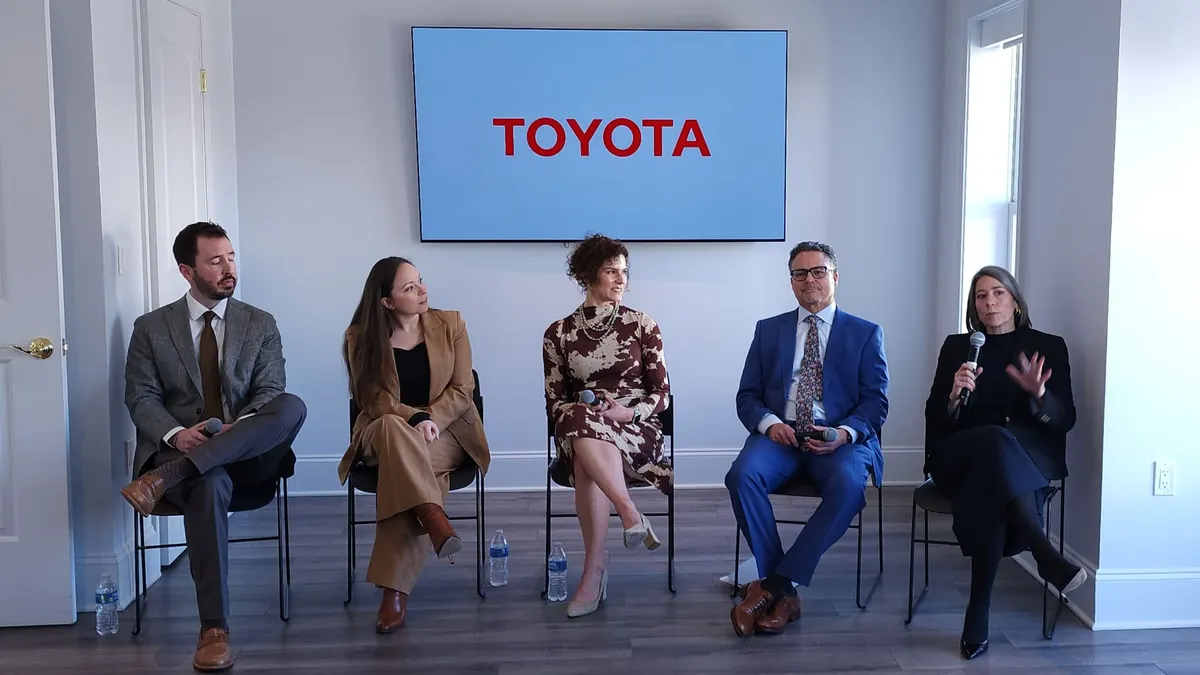

WASHINGTON — Toyota is preparing for the U.S. federal government’s review of the United States-Mexico-Canada Agreement, which is set to begin July 1, Adam Farris, the automaker’s director of International Trade and Supply Chains, said during a company event at the CTA Innovation House on Wednesday.
“Oftentimes, when we talk about tariffs or when they hear tariffs in the news, it's really centered on finished vehicle producers or OEMs,” said Lena Moulckers, director of supplier policy outreach at Toyota. “But really the tariffs are also affecting every critical supply chain player out there, namely our automotive parts suppliers, who are often ignored, yet play a critical role in the all the tariff environment.”
Toyota has been supporting its suppliers through the tariffs, Moulcker said, adding that the company’s suppliers have 600 facilities throughout the U.S. and employ over 200,000 workers, and they “all care about stability and certainty.” The USMCA plays a part in providing “that stable framework” that the automotive industry across North America has come to rely on, Moulcker said.
Toyota recently hosted a supplier clinic in Washington, D.C., giving its suppliers an opportunity to share how tariffs are impacting them. One example, Moulcker said, involved an equipment manufacturer specializing in a “certain widget,” but it does not produce equipment to make the widget.
“Yet, they’re indirectly affected by tariffs, even if they try to localize,” Moulcker said, because that manufacturing equipment itself may be imported and subject to tariffs.
Moulcker said that around 80% of manufacturing equipment is comprised of steel and aluminum. So Toyota’s suppliers are going to be faced with a steel and aluminum derivative tariff, even if they try to localize, she explained.
The USMCA is the reason why North America is a global “auto manufacturing powerhouse,” said Leila Afas, VP of global public policy and strategy at Toyota.
“If you recall six years ago, we faced the real risk of NAFTA blowing up or having blanket tariffs throughout the entire auto industry,” Afas added. “And so what USMCA did was really preserve free trade across all three countries and give us a rule book on how we can build more vehicles, build more parts and pay our workers better.”
Without the USMCA, Afas said that supply chains would be shattered and investments would freeze.
The worst-case scenario, she added, would have been 25% tariffs on auto parts, which has been the automaker’s reality since last April. “Every single link in the automotive supply chain has been impacted, including the ships coming in, carrying parts,” she said, which impacts affordability.
Afas also said that supply chains are still being repaired from the COVID-19 crisis, as Toyota’s suppliers were in the midst of recovery when the tariffs were implemented. She said that suppliers account for 75% of a vehicle’s costs.
“A lot of automakers and suppliers are very hopeful that with the USMCA review, that it's going to continue and look at some relief, especially the tariffs on parts coming from Canada and Mexico,” Afas said. “Unfortunately, July 1 is not a decision deadline, so we're not sure what we'll have after that.”
Per the USMCA, if the three countries agree to extend the deal for another 16 years, the expiration date would be updated to 2042, and the next joint review will take place in 2032.
If any of the North American countries do not agree to extend the deal to 2042, then the joint review process would continue annually until all parties agree to extend it, or until the deal expires.
The agreement also includes an automotive rules of origin provision, qualifying products made or acquired within the three countries. As part of the review, Afas asked what the goal would be for the three parties.
“If the goal is to make sure it’s more regional and maybe keep out some other sourcing, then maybe it’s not so much cranking up the dial to 75% or higher,” [regional value content] Afas said.
“If the goal is to make sure that we maintain our status as a manufacturing superpower when it comes to autos, then let's focus on that goal and not get caught up in these things that will actually undermine the goal,” Afas added.
Another way to look at it is from the regulatory side, with no mandate and tech neutrality. Automakers and other manufacturers will comply with various mandates, such as meeting certain emissions targets or using a specific fuel source for vehicles, rather than just building the vehicle.
“The problem is the rules are too complex,” Afas said. “If the regulations are hard to meet, if the tariffs are too high, if we have too many restrictions, the costs are going to go up, and you're going to price us out of those third-country markets. And that's the reality we face.”